We have just learned some devastating news about a friend in our autism community. Michelle is the mom of twin boys, Liam and Connor, who are both on the ASD spectrum. You may recall a previous post where we showed the hand-drawn picture of cats that the boys learned to draw for the first time http://willowjak.blogspot.com/2006_05_28_willowjak_archive.html.
Michelle learned this weekend that Liam has an inoperable brain tumour (diffuse pontine glioma with encasement of the basilar artery.)
Please pray for Liam and his family (Michelle, Jay and Connor) as they try to enjoy the time that they have left with their little boy.
Sunday, July 09, 2006

Friday, July 07, 2006
Globe and Mail Coverage of Today's Announcement
Ontario court rejects autism treatment in schools
KIRK MAKIN
Globe and Mail Update
Families with autistic children were dealt a severe blow Friday morning when the Ontario Court of Appeal overturned a decision ordering special autism treatment within the school system.
The Court disagreed with virtually every major finding in a 2005 lower-court ruling finding that the province had discriminated against children over the age of six by not providing the same costly ABA/IBI treatment available for children under six.
It stressed that governments are better situated to assess the merits and demerits of health-care policy and how far it should go in extending programs aimed at ameliorating disabling conditions.
“In our view, the policy choices made by the government when it established and developed the (program) fell within the range of reasonable alternatives to provide an effective program across the province that balanced the needs of all autistic children,” the court said.
“The age limit fits squarely within the framework of government action that mediates among competing interests and, accordingly, warrants deference by this court.”
In particular, the Court of Appeal ruled that the children of the 29 plaintiffs in the lawsuit were not discriminated against based on their age, nor were they treated so differently than other disabled children so as to breach the constitutional guarantee of equality.
Scott Hutchison, a lawyer for the plaintiffs, said he will study the ruling closely before seeking leave to appeal to the Supreme Court of Canada. “That, ultimately, is where this case needs to be decided,” Mr. Hutchison said in an interview. “My clients are obviously very disappointed with the result of the case.”
Another lawyer for the plaintiffs, Mary Eberts, said that the Court of Appeal “totally obliterated” the findings of fact made by the trial judge in the case. “ She said that while the Court suggested that evidence was missing on many key points, that evidence was painstakingly assembled in the trial court and then simply ignored by the appeal judges.
“The law is a blunt instrument, and this is the law at its bluntest,” she said.
Ms. Eberts said that her clients were devastated by the ruling, expressing particular frustration over the court's misconceptions about autism therapy and their suggestion that parents of autistic children have the option of home-schooling them. The statement showed a great insensitivity and misunderstanding of the reality for people such as her clients, Ms. Eberts said.
“The decision really puts the ball back in the government's court,” she said, noting that Premier Dalton McGuinty explicitly promised before being elected that he would extend autism treatment to children over the age of six.
The judges said in a 3-0 decision that the intensive treatment is focused closely on children under five because it is a “window of opportunity” when they are considered most amenable to its benefits.
Children younger than six are in school and cannot undertake the 20 to 40 hours a week that the treatment entails, they added.
“In our view, this analysis fails to reflect the most critical benefit that flows from the age limit, namely, that it ensures that existing limited resources are distributed to the children during the ages in which they will most benefit from the program,” the court said.
“As the trial judge found and the experts agree, intervention should be provided ‘the earlier the better' in order to access the window of opportunity in young children with autism,” it said. “It was not adequately shown that the treatment can be delivered within the public school system because of the time and intensity it involves, nor was it proved that other treatments could not be effective.”
The plaintiffs are 29 groups of parents whose autistic children were denied autism treatment in the education system at the age of six. They argued that it was discriminatory to refuse treatment on the basis of their children's age.
The province counterattacked with arguments that it has been more generous than most jurisdictions in its funding program. It also maintained that the benefits of the treatment – known as ABA/IBI – are far from clear when it comes to older children.
Lawyers for the province also expressed fears that if the ruling were allowed to stand, it would jeopardize the ability of governments to set their own funding priorities.
In Friday's ruling, the court said that, given the limited capacity of the program, “eliminating the age limit in (the program) would increase the size of the waiting list for services, increase the typical age of new children entering the program and result in available resources being diverted to older children, thus reducing the opportunity for children under age six to receive intensive behavioural intervention at a time when it would be most effective.
“Had the IEIP not had an age limit of six years, it is likely that those respondents would still be on the waiting lists for services through the IEIP.”
The court also ruled that damages were not available against the province because it did not engage in unconstitutional acts of bad faith, abuse of power, negligence or willful blindness.
In her ruling last year, Ontario Superior Court Judge Frances Kiteley said that Ontario had violated the constitutional rights and “human dignity” of autistic schoolchildren by denying them treatment they desperately need in order to cope and thrive. She found discrimination based on age and disability.
“I find that the age cutoff reflects and reinforces the stereotype that children with autism over age 6 are virtually unredeemable,” Judge Kiteley said in her ruling. “To deny the plaintiff children the opportunity to have [treatment] after the age of 5 is to stereotype them, to prejudice them and to create a disadvantage for them.”
She awarded damages to the litigants that ran into the millions of dollars for past and future treatment. Going further, Judge Kiteley refused a request from the province for a grace period in which to repair its delivery of autism programs, saying it has had ample time to fix the problem.
The ruling has clear implications across the country, signalling that it may very well be destined for an airing in the Supreme Court of Canada.
In a 2004 ruling known as Auton, the Supreme Court declared that provinces have no obligation to provide ABA/IBI treatment under the health-care system. However, yesterday's case – known as Deskin-Wynberg – instead attacked the problem through the context of the education system.
In her exhaustive, 217-page decision, Judge Kiteley ruled that Ontario broke an explicit promise in the Education Act to meet the needs of disabled children, and then failed abysmally to evaluate its existing programs.
Without treatment, Judge Kiteley said, “the plaintiff children are deprived of the skills they need for full membership in the human community. That child's isolation and lack of skills mean that s/he cannot participate in society and cannot exercise the rights and freedoms to which all Canadians are entitled.
“The absence of ABA/IBI means that children with autism are excluded from the opportunity to access learning with the consequential deprivation of skills, the likelihood of isolation from society and the loss of the ability to exercise the rights and freedoms to which all Canadians are entitled.”
Judge Kiteley refused to let the Ministry of Education slough off its responsibility onto individual school boards. “The challenges faced by parents demonstrate that when left to individual school boards, parents are constantly reinventing the wheel,” she said.
Autism affects from two to six children in every 1,000. Behaviour can include a fixation on moving objects, self-injurious conduct, an inability to concentrate or process information and great difficulty engaging in normal social interaction.
The therapy of choice for autistic children is referred to interchangeably as ABA or IBI. Therapists break down language and mental and physical tasks into components that are repeated until an autistic child masters them.
While the most intensive form of the treatment requires considerable supervision and can cost up to $60,000 a year for each child, many authorities consider it the difference between a child's growing up to be relatively normal and one who is doomed to a highly dysfunctional life.
Proponents of the treatment argue that the special needs of autistic children are no less dramatic than those of blind or deaf children – who are well accommodated in the school system. Judge Kiteley agreed that there has been a stubborn refusal by education officials at all levels – apart from a few “open-minded” principals or teachers – to recognize ABA/IBI as an education tool rather than a medical therapy.
ABA/IBI treatment must begin early and continue as long as it is effective, Judge Kiteley said. “I find that a systematic ineligibility criterion of age 6 cannot be responsive to the needs of the child.”
She flatly disagreed with government claims that ABA/IBI is simply an experimental, emergent therapy – in direct contrast with the Supreme Court's Auton ruling.
She said it “undermines the integrity of the government” that it has adopted inconsistent positions on the usefulness of ABA/IBI, and that it has sunk millions of dollars into evaluating a therapy it continues to claim is ‘emergent.'
KIRK MAKIN
Globe and Mail Update
Families with autistic children were dealt a severe blow Friday morning when the Ontario Court of Appeal overturned a decision ordering special autism treatment within the school system.
The Court disagreed with virtually every major finding in a 2005 lower-court ruling finding that the province had discriminated against children over the age of six by not providing the same costly ABA/IBI treatment available for children under six.
It stressed that governments are better situated to assess the merits and demerits of health-care policy and how far it should go in extending programs aimed at ameliorating disabling conditions.
“In our view, the policy choices made by the government when it established and developed the (program) fell within the range of reasonable alternatives to provide an effective program across the province that balanced the needs of all autistic children,” the court said.
“The age limit fits squarely within the framework of government action that mediates among competing interests and, accordingly, warrants deference by this court.”
In particular, the Court of Appeal ruled that the children of the 29 plaintiffs in the lawsuit were not discriminated against based on their age, nor were they treated so differently than other disabled children so as to breach the constitutional guarantee of equality.
Scott Hutchison, a lawyer for the plaintiffs, said he will study the ruling closely before seeking leave to appeal to the Supreme Court of Canada. “That, ultimately, is where this case needs to be decided,” Mr. Hutchison said in an interview. “My clients are obviously very disappointed with the result of the case.”
Another lawyer for the plaintiffs, Mary Eberts, said that the Court of Appeal “totally obliterated” the findings of fact made by the trial judge in the case. “ She said that while the Court suggested that evidence was missing on many key points, that evidence was painstakingly assembled in the trial court and then simply ignored by the appeal judges.
“The law is a blunt instrument, and this is the law at its bluntest,” she said.
Ms. Eberts said that her clients were devastated by the ruling, expressing particular frustration over the court's misconceptions about autism therapy and their suggestion that parents of autistic children have the option of home-schooling them. The statement showed a great insensitivity and misunderstanding of the reality for people such as her clients, Ms. Eberts said.
“The decision really puts the ball back in the government's court,” she said, noting that Premier Dalton McGuinty explicitly promised before being elected that he would extend autism treatment to children over the age of six.
The judges said in a 3-0 decision that the intensive treatment is focused closely on children under five because it is a “window of opportunity” when they are considered most amenable to its benefits.
Children younger than six are in school and cannot undertake the 20 to 40 hours a week that the treatment entails, they added.
“In our view, this analysis fails to reflect the most critical benefit that flows from the age limit, namely, that it ensures that existing limited resources are distributed to the children during the ages in which they will most benefit from the program,” the court said.
“As the trial judge found and the experts agree, intervention should be provided ‘the earlier the better' in order to access the window of opportunity in young children with autism,” it said. “It was not adequately shown that the treatment can be delivered within the public school system because of the time and intensity it involves, nor was it proved that other treatments could not be effective.”
The plaintiffs are 29 groups of parents whose autistic children were denied autism treatment in the education system at the age of six. They argued that it was discriminatory to refuse treatment on the basis of their children's age.
The province counterattacked with arguments that it has been more generous than most jurisdictions in its funding program. It also maintained that the benefits of the treatment – known as ABA/IBI – are far from clear when it comes to older children.
Lawyers for the province also expressed fears that if the ruling were allowed to stand, it would jeopardize the ability of governments to set their own funding priorities.
In Friday's ruling, the court said that, given the limited capacity of the program, “eliminating the age limit in (the program) would increase the size of the waiting list for services, increase the typical age of new children entering the program and result in available resources being diverted to older children, thus reducing the opportunity for children under age six to receive intensive behavioural intervention at a time when it would be most effective.
“Had the IEIP not had an age limit of six years, it is likely that those respondents would still be on the waiting lists for services through the IEIP.”
The court also ruled that damages were not available against the province because it did not engage in unconstitutional acts of bad faith, abuse of power, negligence or willful blindness.
In her ruling last year, Ontario Superior Court Judge Frances Kiteley said that Ontario had violated the constitutional rights and “human dignity” of autistic schoolchildren by denying them treatment they desperately need in order to cope and thrive. She found discrimination based on age and disability.
“I find that the age cutoff reflects and reinforces the stereotype that children with autism over age 6 are virtually unredeemable,” Judge Kiteley said in her ruling. “To deny the plaintiff children the opportunity to have [treatment] after the age of 5 is to stereotype them, to prejudice them and to create a disadvantage for them.”
She awarded damages to the litigants that ran into the millions of dollars for past and future treatment. Going further, Judge Kiteley refused a request from the province for a grace period in which to repair its delivery of autism programs, saying it has had ample time to fix the problem.
The ruling has clear implications across the country, signalling that it may very well be destined for an airing in the Supreme Court of Canada.
In a 2004 ruling known as Auton, the Supreme Court declared that provinces have no obligation to provide ABA/IBI treatment under the health-care system. However, yesterday's case – known as Deskin-Wynberg – instead attacked the problem through the context of the education system.
In her exhaustive, 217-page decision, Judge Kiteley ruled that Ontario broke an explicit promise in the Education Act to meet the needs of disabled children, and then failed abysmally to evaluate its existing programs.
Without treatment, Judge Kiteley said, “the plaintiff children are deprived of the skills they need for full membership in the human community. That child's isolation and lack of skills mean that s/he cannot participate in society and cannot exercise the rights and freedoms to which all Canadians are entitled.
“The absence of ABA/IBI means that children with autism are excluded from the opportunity to access learning with the consequential deprivation of skills, the likelihood of isolation from society and the loss of the ability to exercise the rights and freedoms to which all Canadians are entitled.”
Judge Kiteley refused to let the Ministry of Education slough off its responsibility onto individual school boards. “The challenges faced by parents demonstrate that when left to individual school boards, parents are constantly reinventing the wheel,” she said.
Autism affects from two to six children in every 1,000. Behaviour can include a fixation on moving objects, self-injurious conduct, an inability to concentrate or process information and great difficulty engaging in normal social interaction.
The therapy of choice for autistic children is referred to interchangeably as ABA or IBI. Therapists break down language and mental and physical tasks into components that are repeated until an autistic child masters them.
While the most intensive form of the treatment requires considerable supervision and can cost up to $60,000 a year for each child, many authorities consider it the difference between a child's growing up to be relatively normal and one who is doomed to a highly dysfunctional life.
Proponents of the treatment argue that the special needs of autistic children are no less dramatic than those of blind or deaf children – who are well accommodated in the school system. Judge Kiteley agreed that there has been a stubborn refusal by education officials at all levels – apart from a few “open-minded” principals or teachers – to recognize ABA/IBI as an education tool rather than a medical therapy.
ABA/IBI treatment must begin early and continue as long as it is effective, Judge Kiteley said. “I find that a systematic ineligibility criterion of age 6 cannot be responsive to the needs of the child.”
She flatly disagreed with government claims that ABA/IBI is simply an experimental, emergent therapy – in direct contrast with the Supreme Court's Auton ruling.
She said it “undermines the integrity of the government” that it has adopted inconsistent positions on the usefulness of ABA/IBI, and that it has sunk millions of dollars into evaluating a therapy it continues to claim is ‘emergent.'
Seems Like Spin Control to me...
Here is what Queen's Park announced right before Shelley Martel held her own Press Conference at 2pm today. Do you think the McGuinty Govt are trying to convince us parents that we have nothing to worry about in Ontario???
----------------------
Attention News Editors:
McGuinty Government Committed to Helping Children and Youth with Autism
QUEEN'S PARK, ON, July 7 /CNW/ - The McGuinty government is committed to
providing services to children and youth with autism regardless of age,
Minister of Children and Youth Services Mary Anne Chambers and Minister of
Education Sandra Pupatello announced today.
"More children have access to more services than ever before, and that
will continue regardless of age," Chambers said. "The McGuinty government is
building and improving the continuum of services for Ontario children and
youth with autism from the time they are diagnosed right through their school
years to help meet their changing needs."
Since taking office in October 2003, the McGuinty government has more
than doubled its investment in services for children and youth with autism and
their families, to more than $112 million annually.
The province has increased the number of trained therapists and enhanced
support in schools for children with autism. In July 2005, the Ministry of
Children and Youth Services directed regional autism service providers to
assess all children referred to the autism intervention program in a
consistent manner, and that no child should be discharged based on age. Today,
Chambers confirmed that services remain in place for all children with autism
regardless of age to help meet their needs.
"Ontario children do not age out of autism services," said Chambers. "We
believe looking after our most vulnerable children and youth is an important
investment to make on behalf of Ontario families. That's why we are developing
a system that offers children and youth with autism and their families greater
integration of services, best practices and the best trained individuals."
As a result of new investments, the number of children receiving IBI will
have increased by 70 per cent since April 2004, and the number of children
waiting for assessments has been reduced by 68 per cent.
"The government will continue working with our partners, including
parents and educators, to look for new ways to strengthen and improve the
services and supports available for students with special education needs,
including those with autism," said Pupatello.
Pupatello recently announced a new approach to special education to
support better outcomes for students with special education needs. The
government also announced a $50 million investment to reduce waiting times for
student assessments and to enhance professional development for school board
staff.
The McGuinty government's plan for children with special needs also
includes:
<< - A $33 million increased investment in the Special Education Grant for 2006-07, bringing the total increase in the grant to $309 million since coming to office - Hiring more than 110 new Intensive Behavioural Intervention (IBI) therapists since 2003-04 - Increasing the pool of qualified autism professionals through the creation of an Ontario College Graduate Certificate Program in Autism and Behavioural Science - Investing in training for teachers' assistants and early childhood educators to learn how to better support children with autism. Disponible en français www.children.gov.on.ca www.edu.gov.on.ca www.resultsontario.gov.on.ca Backgrounder ------------------------------------------------------------------------- BUILDING AND IMPROVING THE CONTINUUM OF SERVICES FOR ONTARIO CHILDREN AND YOUTH WITH AUTISM The Ministry of Children and Youth Services is committed to providing a continuum of services to support children and youth with autism. The province's investment in autism services is now more than $112 million annually. INVESTING IN SERVICES Since taking office, the McGuinty government has: - More than doubled spending on services for children and youth with autism - Added more than 110 new therapists, increasing the number of children receiving Intensive Behavioural Intervention (IBI) to 795 as of March 2006 - Invested an additional $13.1 million this year to deliver IBI to an estimated 120 more children and provide additional supports to children and youth with autism and their families. It will also fund services for youth with autism who will be provided a better chance to make a successful transition to adolescence, through increased behavioural supports, crisis intervention, and skills-based training through special-needs service agencies. - Provided $1 million to help Autism Society Ontario (ASO) provide more supports to families of children and youth with ASD, including parent support networks, training, resource materials and access to consultation with ASD specialists - Provided $2 million in each of the next three years to provide training, through the Geneva Centre for Autism, for up to 1,600 child care workers and early childhood educators who work with children with ASD - Invested $10 million more annually to Ontario's children's treatment centres to provide services to approximately 4,800 more children and youth with complex special needs, including autism - Through the Ministry of Education, providing $5 million over two years to the Geneva Centre for Autism to provide training for teachers' assistants who work with students with ASD. In 2004-05, school boards across the province identified approximately 7,000 students with ASD PROVIDING A CONTINUUM OF SERVICES The range of services in the Ministry of Children and Youth Services' autism intervention program includes: - Intensive Behavioural Intervention (IBI), which is a structured approach to breaking down the barriers that isolate children with autism from the world around them. IBI professionals work with children with autism - either one-on-one or in small groups. They use systematic methods derived from principles of Applied Behaviour Analysis (ABA), an approach to understanding and changing behaviour and to teaching skills. ABA includes a variety of methods for assessing children's behaviours and learning needs, and for intervening using techniques to teach alternative skills and behaviours to promote positive development. - Transition services and supports are provided to facilitate the integration of children into new environments. Transition planning begins early and is part of each child's Individual Program Plan (IPP). Each child will have a transition plan that reflects individual strengths and needs. The plan is integrated with other service providers involved with the family and existing community transition processes to promote smooth transitions, including the entry to school planning provided by the Ministry of Education. - Child and Family Supports are available to assist families of children with referrals to other community supports and services, including information about autism, effective reinforcement strategies and promoting social interaction to families waiting for IBI. These families may also be provided with training specifically to help ready their child for IBI, to promote skill development and to foster integration into small groups. - The School Support Program has 188 Autism Spectrum Disorder Consultants who help teachers and educators better understand how children and youth with autism learn and how the principles of ABA can help improve their learning. Training and information for teachers and other educators are provided to help them better understand how to improve the learning experience for children with autism in schools. Since it was established in 2004, thousands of contacts with teachers, educational assistants, as well as other regular and special education staff, have occurred across the province. Children with autism may also benefit from a range of other services available in communities across the province, such as: - Special Needs Resourcing in local preschool or day care centres is designed to promote the full integration of infants and children with special needs. - The Infant Development Program is part of a continuum of early intervention services for children who have, or are at risk of, developmental delays. The program provides home and in-centre support for sensory stimulation, motor development, communication skills, social interaction, emotional development, self-help skills and to help parents recognize, understand and adjust to their child's special needs. - The Special Services at Home (SSAH) Program helps children with developmental or physical disabilities and adults with a developmental disability to live at home with their families by providing funding on a time-limited basis to address individual needs. With this funding, families can purchase supports and services which they could not normally provide themselves and are not available elsewhere in the community. - Out-of-home Respite Services for children with multiple special needs requiring the greatest amount of care. Families of children with multiple special needs can receive up to seven days of respite per year, provided in a location other than their own home. - Enhanced Respite Funding is provided to families caring for a medically fragile and/or technologically dependent child living at home, whose care requires ongoing, frequent and time-consuming intervention on a 24-hour basis. - The Behaviour Management Program provides various services such as assessment and/or treatment of behaviour issues for children with special needs through community hospitals and local community support agencies. - The Assistance for Children with Severe Disabilities (ACSD) Program provides help to parents to assist with some of the extra costs of caring for a child who has a disability. The purpose of the benefit is to help children who have disabilities live as normal a life as possible at home and in the community. - Mental Health Services are delivered to children and youth by numerous community agencies located throughout the province. OTHER GOVERNMENT INITIATIVES - Engagement of parents, researchers and autism service providers through a provincial advisory group on ways to serve children and youth with autism spectrum disorder (ASD) and their families - In partnership with the Ministry of Education, establishing a reference group to provide recommendations on effective practices that school boards can use to improve the learning environment for students with ASD - Increasing the pool of qualified autism professionals through the creation last year of an Ontario College Graduate Certificate Program in Autism and Behavioural Science, in partnership with the Ministry of Training, Colleges and Universities - Advancing research and expertise in ASD, in partnership with the Ministry of Training, Colleges and Universities and the Ontario Council of Graduate Studies, through the establishment of the first Endowed Chair in Autism and Behavioural Science at the University of Western Ontario, as well as an Autism Scholar Awards program - Program evaluation of children's outcomes to date in the autism intervention program (previously referred to as The Early Intensive Behavioural Intervention Program) - Together with the Ministry of Education, reviewing the first year implementation of the School Support Program - Autism Spectrum Disorder to identify best practices and learn from the experiences of service providers and school boards. The Ministry of Education has introduced reforms that will help support better outcomes for children with special needs, including, but not limited to: - School boards' special education plans will be transformed so they focus on target setting and improvement planning that is related to student achievement and program effectiveness. - The ministry is encouraging boards to streamline the identification, placement and review committee process to reduce barriers or delays to accessing special education programs and services. - The ministry will be working with school boards to reinforce the connection between a student's Individual Education Plan, the Ontario curriculum and the provincial report card. - A resource guide on effective teaching practices for students with autism will be distributed to school boards. - The Ontario Psychological Association is working with school boards to reduce current waiting times for students who require assessments and to enhance the capacity of teachers to provide effective programs for students. - School boards will be required to develop informal dispute resolution processes for issues regarding special education programs and services. - A provincial policy on mediation processes for special education programs and services will be developed in consultation with stakeholders, including a process for recognizing the credentials of mediators. - $25 million for Council of Ontario Directors of Education to support school board projects that improve instructional practices, enhance system capacity and support better achievement for students with special education needs. Disponible en français www.children.gov.on.ca www.edu.gov.on.ca >>
For further information: James Ip, Minister's Office, (416) 212-7157;
Anne Machowski-Smith, Ministry of Children and Youth Services, (416) 325-5156;
Valerie Poulin, Minister's Office, (416) 325-2632; Tanya Blazina, Ministry of
Education, (416) 325-2746; Public Inquiries: (416) 325-2929 or 1-800-387-5514,
TTY: 1-800-263-2892
----------------------
Attention News Editors:
McGuinty Government Committed to Helping Children and Youth with Autism
QUEEN'S PARK, ON, July 7 /CNW/ - The McGuinty government is committed to
providing services to children and youth with autism regardless of age,
Minister of Children and Youth Services Mary Anne Chambers and Minister of
Education Sandra Pupatello announced today.
"More children have access to more services than ever before, and that
will continue regardless of age," Chambers said. "The McGuinty government is
building and improving the continuum of services for Ontario children and
youth with autism from the time they are diagnosed right through their school
years to help meet their changing needs."
Since taking office in October 2003, the McGuinty government has more
than doubled its investment in services for children and youth with autism and
their families, to more than $112 million annually.
The province has increased the number of trained therapists and enhanced
support in schools for children with autism. In July 2005, the Ministry of
Children and Youth Services directed regional autism service providers to
assess all children referred to the autism intervention program in a
consistent manner, and that no child should be discharged based on age. Today,
Chambers confirmed that services remain in place for all children with autism
regardless of age to help meet their needs.
"Ontario children do not age out of autism services," said Chambers. "We
believe looking after our most vulnerable children and youth is an important
investment to make on behalf of Ontario families. That's why we are developing
a system that offers children and youth with autism and their families greater
integration of services, best practices and the best trained individuals."
As a result of new investments, the number of children receiving IBI will
have increased by 70 per cent since April 2004, and the number of children
waiting for assessments has been reduced by 68 per cent.
"The government will continue working with our partners, including
parents and educators, to look for new ways to strengthen and improve the
services and supports available for students with special education needs,
including those with autism," said Pupatello.
Pupatello recently announced a new approach to special education to
support better outcomes for students with special education needs. The
government also announced a $50 million investment to reduce waiting times for
student assessments and to enhance professional development for school board
staff.
The McGuinty government's plan for children with special needs also
includes:
<< - A $33 million increased investment in the Special Education Grant for 2006-07, bringing the total increase in the grant to $309 million since coming to office - Hiring more than 110 new Intensive Behavioural Intervention (IBI) therapists since 2003-04 - Increasing the pool of qualified autism professionals through the creation of an Ontario College Graduate Certificate Program in Autism and Behavioural Science - Investing in training for teachers' assistants and early childhood educators to learn how to better support children with autism. Disponible en français www.children.gov.on.ca www.edu.gov.on.ca www.resultsontario.gov.on.ca Backgrounder ------------------------------------------------------------------------- BUILDING AND IMPROVING THE CONTINUUM OF SERVICES FOR ONTARIO CHILDREN AND YOUTH WITH AUTISM The Ministry of Children and Youth Services is committed to providing a continuum of services to support children and youth with autism. The province's investment in autism services is now more than $112 million annually. INVESTING IN SERVICES Since taking office, the McGuinty government has: - More than doubled spending on services for children and youth with autism - Added more than 110 new therapists, increasing the number of children receiving Intensive Behavioural Intervention (IBI) to 795 as of March 2006 - Invested an additional $13.1 million this year to deliver IBI to an estimated 120 more children and provide additional supports to children and youth with autism and their families. It will also fund services for youth with autism who will be provided a better chance to make a successful transition to adolescence, through increased behavioural supports, crisis intervention, and skills-based training through special-needs service agencies. - Provided $1 million to help Autism Society Ontario (ASO) provide more supports to families of children and youth with ASD, including parent support networks, training, resource materials and access to consultation with ASD specialists - Provided $2 million in each of the next three years to provide training, through the Geneva Centre for Autism, for up to 1,600 child care workers and early childhood educators who work with children with ASD - Invested $10 million more annually to Ontario's children's treatment centres to provide services to approximately 4,800 more children and youth with complex special needs, including autism - Through the Ministry of Education, providing $5 million over two years to the Geneva Centre for Autism to provide training for teachers' assistants who work with students with ASD. In 2004-05, school boards across the province identified approximately 7,000 students with ASD PROVIDING A CONTINUUM OF SERVICES The range of services in the Ministry of Children and Youth Services' autism intervention program includes: - Intensive Behavioural Intervention (IBI), which is a structured approach to breaking down the barriers that isolate children with autism from the world around them. IBI professionals work with children with autism - either one-on-one or in small groups. They use systematic methods derived from principles of Applied Behaviour Analysis (ABA), an approach to understanding and changing behaviour and to teaching skills. ABA includes a variety of methods for assessing children's behaviours and learning needs, and for intervening using techniques to teach alternative skills and behaviours to promote positive development. - Transition services and supports are provided to facilitate the integration of children into new environments. Transition planning begins early and is part of each child's Individual Program Plan (IPP). Each child will have a transition plan that reflects individual strengths and needs. The plan is integrated with other service providers involved with the family and existing community transition processes to promote smooth transitions, including the entry to school planning provided by the Ministry of Education. - Child and Family Supports are available to assist families of children with referrals to other community supports and services, including information about autism, effective reinforcement strategies and promoting social interaction to families waiting for IBI. These families may also be provided with training specifically to help ready their child for IBI, to promote skill development and to foster integration into small groups. - The School Support Program has 188 Autism Spectrum Disorder Consultants who help teachers and educators better understand how children and youth with autism learn and how the principles of ABA can help improve their learning. Training and information for teachers and other educators are provided to help them better understand how to improve the learning experience for children with autism in schools. Since it was established in 2004, thousands of contacts with teachers, educational assistants, as well as other regular and special education staff, have occurred across the province. Children with autism may also benefit from a range of other services available in communities across the province, such as: - Special Needs Resourcing in local preschool or day care centres is designed to promote the full integration of infants and children with special needs. - The Infant Development Program is part of a continuum of early intervention services for children who have, or are at risk of, developmental delays. The program provides home and in-centre support for sensory stimulation, motor development, communication skills, social interaction, emotional development, self-help skills and to help parents recognize, understand and adjust to their child's special needs. - The Special Services at Home (SSAH) Program helps children with developmental or physical disabilities and adults with a developmental disability to live at home with their families by providing funding on a time-limited basis to address individual needs. With this funding, families can purchase supports and services which they could not normally provide themselves and are not available elsewhere in the community. - Out-of-home Respite Services for children with multiple special needs requiring the greatest amount of care. Families of children with multiple special needs can receive up to seven days of respite per year, provided in a location other than their own home. - Enhanced Respite Funding is provided to families caring for a medically fragile and/or technologically dependent child living at home, whose care requires ongoing, frequent and time-consuming intervention on a 24-hour basis. - The Behaviour Management Program provides various services such as assessment and/or treatment of behaviour issues for children with special needs through community hospitals and local community support agencies. - The Assistance for Children with Severe Disabilities (ACSD) Program provides help to parents to assist with some of the extra costs of caring for a child who has a disability. The purpose of the benefit is to help children who have disabilities live as normal a life as possible at home and in the community. - Mental Health Services are delivered to children and youth by numerous community agencies located throughout the province. OTHER GOVERNMENT INITIATIVES - Engagement of parents, researchers and autism service providers through a provincial advisory group on ways to serve children and youth with autism spectrum disorder (ASD) and their families - In partnership with the Ministry of Education, establishing a reference group to provide recommendations on effective practices that school boards can use to improve the learning environment for students with ASD - Increasing the pool of qualified autism professionals through the creation last year of an Ontario College Graduate Certificate Program in Autism and Behavioural Science, in partnership with the Ministry of Training, Colleges and Universities - Advancing research and expertise in ASD, in partnership with the Ministry of Training, Colleges and Universities and the Ontario Council of Graduate Studies, through the establishment of the first Endowed Chair in Autism and Behavioural Science at the University of Western Ontario, as well as an Autism Scholar Awards program - Program evaluation of children's outcomes to date in the autism intervention program (previously referred to as The Early Intensive Behavioural Intervention Program) - Together with the Ministry of Education, reviewing the first year implementation of the School Support Program - Autism Spectrum Disorder to identify best practices and learn from the experiences of service providers and school boards. The Ministry of Education has introduced reforms that will help support better outcomes for children with special needs, including, but not limited to: - School boards' special education plans will be transformed so they focus on target setting and improvement planning that is related to student achievement and program effectiveness. - The ministry is encouraging boards to streamline the identification, placement and review committee process to reduce barriers or delays to accessing special education programs and services. - The ministry will be working with school boards to reinforce the connection between a student's Individual Education Plan, the Ontario curriculum and the provincial report card. - A resource guide on effective teaching practices for students with autism will be distributed to school boards. - The Ontario Psychological Association is working with school boards to reduce current waiting times for students who require assessments and to enhance the capacity of teachers to provide effective programs for students. - School boards will be required to develop informal dispute resolution processes for issues regarding special education programs and services. - A provincial policy on mediation processes for special education programs and services will be developed in consultation with stakeholders, including a process for recognizing the credentials of mediators. - $25 million for Council of Ontario Directors of Education to support school board projects that improve instructional practices, enhance system capacity and support better achievement for students with special education needs. Disponible en français www.children.gov.on.ca www.edu.gov.on.ca >>
For further information: James Ip, Minister's Office, (416) 212-7157;
Anne Machowski-Smith, Ministry of Children and Youth Services, (416) 325-5156;
Valerie Poulin, Minister's Office, (416) 325-2632; Tanya Blazina, Ministry of
Education, (416) 325-2746; Public Inquiries: (416) 325-2929 or 1-800-387-5514,
TTY: 1-800-263-2892
Ont. wins appeal on childhood autism therapy
Ont. wins appeal on childhood autism therapy
April Lindgren
CanWest News Service
Friday, July 07, 2006
TORONTO -- The Ontario government is not discriminating when it limits intensive treatment for autistic children to tots between two and five years old, the Ontario Court of Appeal ruled Friday.
The decision represents a victory for the government, which had appealed a lower court judgment that found children who are denied the treatment upon entering school at age six are victims of discrimination based on age and disability.
The original suit, brought by 29 parents, sent shock waves through the provincial government because of the potential cost involved in extending the intensive one-on-one therapy that costs up to $60,000 annually per child. Some estimates suggest s many as one in 200 children are born with autism spectrum disorder.
Responding to the original decision back in April 2005, Premier Dalton McGuinty said he was concerned by a court ruling that requires a government to spend money it might not have.
The premier also said children with autism represent only a minority of youngsters with special needs.
“Do they then go to court on an ongoing basis for each and every one of their very special concerns and demand that the Province of Ontario be mandated to make certain expenditures to help out those families?”
When he was in opposition, McGuinty wrote to parents of autistic children promising to extend the intensive therapy to children six and older if he formed the next government.
April Lindgren
CanWest News Service
Friday, July 07, 2006
TORONTO -- The Ontario government is not discriminating when it limits intensive treatment for autistic children to tots between two and five years old, the Ontario Court of Appeal ruled Friday.
The decision represents a victory for the government, which had appealed a lower court judgment that found children who are denied the treatment upon entering school at age six are victims of discrimination based on age and disability.
The original suit, brought by 29 parents, sent shock waves through the provincial government because of the potential cost involved in extending the intensive one-on-one therapy that costs up to $60,000 annually per child. Some estimates suggest s many as one in 200 children are born with autism spectrum disorder.
Responding to the original decision back in April 2005, Premier Dalton McGuinty said he was concerned by a court ruling that requires a government to spend money it might not have.
The premier also said children with autism represent only a minority of youngsters with special needs.
“Do they then go to court on an ongoing basis for each and every one of their very special concerns and demand that the Province of Ontario be mandated to make certain expenditures to help out those families?”
When he was in opposition, McGuinty wrote to parents of autistic children promising to extend the intensive therapy to children six and older if he formed the next government.
Happy Birthday to Poppa
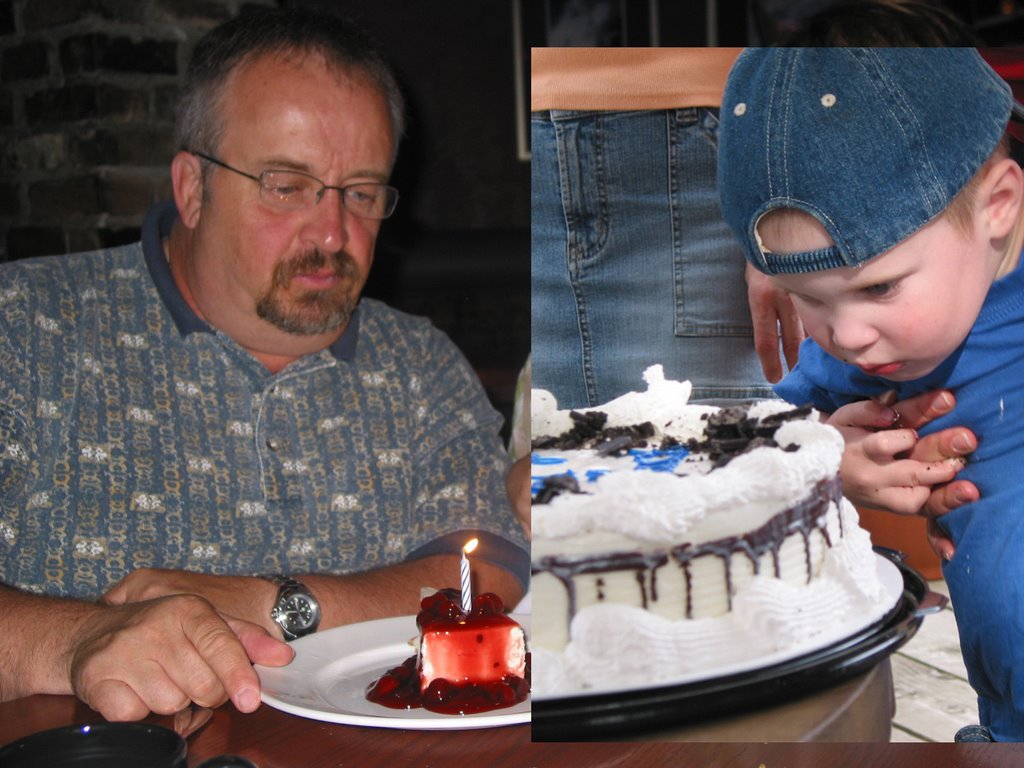
On Wednesday night, Jake, Nonna, Pop, Auntie Boom, Jonathan and I all went out to celebrate Pop's birthday at The Keg.
 It was a great meal and a lot of fun. Jake entertained us with his jokes: "Why did the chewing gum cross the road? Because it was stuck on somebody's shoe".
 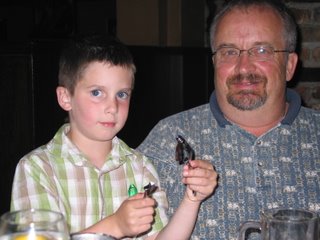 Pop entertained us by breaking the lobster "cracker" while trying to teach Steph how to eat lobster and Nonna & Pop nearly made me cry when they gave me a beautiful going away card with a gift that I can't wait to put on our new mantle. The WillowTree figures are quickly becoming my favourite things; not only because of their simplistic beauty, but because of the significance of the 'Willow Tree'.
It was a great meal and a lot of fun. Jake entertained us with his jokes: "Why did the chewing gum cross the road? Because it was stuck on somebody's shoe". Pop entertained us by breaking the lobster "cracker" while trying to teach Steph how to eat lobster and Nonna & Pop nearly made me cry when they gave me a beautiful going away card with a gift that I can't wait to put on our new mantle. The WillowTree figures are quickly becoming my favourite things; not only because of their simplistic beauty, but because of the significance of the 'Willow Tree'.
Goodbyes are getting harder and harder, but lucky for us, this dinner was not a goodbye, but just a pre-cursor to one -- but by the look of Pop's eyes tearing up everytime he looked at Jake, we know we're in for a tough time when the real goodbyes start next week.

Kids over 5 with Autism in Ontario lose again...
It's a sad, sad day for our friends in the autism community in Ontario. I felt sick at seeing the news when I checked online at 11 this morning. Let's pray that there is still hope that the Supreme Court of Canada gets involved somehow to overturn the decision or else all of our friends with kids over the age of 5 may be joining us in Calgary (that wouldn't be a bad thing for us)....
Ontario wins appeal on childhood autism therapy
Updated Fri. Jul. 7 2006 12:08 PM ET
CTV.ca News Staff
Ontario taxpayers are off the hook when it comes to paying for the costly treatment of autistic children over the age of five, the Ontario Court of Appeal ruled Friday.
The decision -- worth tens of millions of dollars -- comes after a lower court ruled in favour of parents who are forced to bear the expense.
The lower court found the government's decision to cut off funding for autism therapy after the child turned six to be discriminatory and ordered it to pay.
The government appealed, and the Appeal Court agreed with the province, saying the aim of the age cut-off was to help the younger children more effectively.
The cost of the intensive one-on-one process, known either as applied behavioural analysis or intensive behavioural intervention ranges from $30,000 to $80,000 per year for each child.
It's estimated that about 8,000 children under the age of 18 have been diagnosed with autism in the province.
Previously, Alberta was the only province in Canada to pay for autism treatment and therapy, prompting many Ontario familes to travel to Alberta to seek costly treatments.
With files from the Canadian Press
Be sure to watch CTV and Global News tonight. I know that our friend, Andrew Kavchuck was interviewed by CBC Radio in Ottawa, as was Nancy Morisson by Global. MPP Shelley Martel is holding a press conference to discuss the ruling at 2pm today at Queen's Park.
Ontario wins appeal on childhood autism therapy
Updated Fri. Jul. 7 2006 12:08 PM ET
CTV.ca News Staff
Ontario taxpayers are off the hook when it comes to paying for the costly treatment of autistic children over the age of five, the Ontario Court of Appeal ruled Friday.
The decision -- worth tens of millions of dollars -- comes after a lower court ruled in favour of parents who are forced to bear the expense.
The lower court found the government's decision to cut off funding for autism therapy after the child turned six to be discriminatory and ordered it to pay.
The government appealed, and the Appeal Court agreed with the province, saying the aim of the age cut-off was to help the younger children more effectively.
The cost of the intensive one-on-one process, known either as applied behavioural analysis or intensive behavioural intervention ranges from $30,000 to $80,000 per year for each child.
It's estimated that about 8,000 children under the age of 18 have been diagnosed with autism in the province.
Previously, Alberta was the only province in Canada to pay for autism treatment and therapy, prompting many Ontario familes to travel to Alberta to seek costly treatments.
With files from the Canadian Press
Be sure to watch CTV and Global News tonight. I know that our friend, Andrew Kavchuck was interviewed by CBC Radio in Ottawa, as was Nancy Morisson by Global. MPP Shelley Martel is holding a press conference to discuss the ruling at 2pm today at Queen's Park.
Wednesday, July 05, 2006
The Alberta Attraction - Saskatoon Star Pheonix
The following news story features the family we have told some of you about, that we met while on our second visit to check out Calgary. Gabriel is the little boy whose therapy session we were invited to watch in his home...
----------------------------------------------
The Alberta attraction
Saskatoon StarPheonix
Jul 4, 2006
Byline: James Wood
REGINA -- Keeping up with the Joneses is always problem.
For Saskatchewan, the problem is magnifi ed when province's people simply decide to move next door become Joneses themselves.
Alberta's strong economy has long been a magnet Saskatchewan residents, serving as a major factor in Saskatchewan's historically stagnant population.
In recent years, situation has intensifi as the Alberta economy has flared red-hot.
While Saskatchewan's coffers are full and its gross domestic product is growing thanks to high and natural gas prices, Alberta's energy resources have brought a gusher of wealth next door.
Alberta's wages the highest in Canada while the taxes are lowest, the provincial government is spending on services and the main cities are booming.
In the last two years alone, more than 23,000 Saskatchewan residents migrated to Alberta. While the population does fl ow both ways between the two provinces, the net loss from Saskatchewan to Alberta was still more than 7,000 people.
Scott Newell, a 35-year-old graduate of the University of Saskatchewan law school, left a practice in Saskatoon for Calgary law fi rm Parlee McLaws LLP in 2000 and he's seen the population of Saskatchewan transplants grow ever since.
Like many professionals, he was attracted by more money, greater opportunities and a faster pace.
"You just sort of have more options. There's more restaurants to go to, there's more bars to go to, you're close to the mountains.
There's just, I guess, more amenities available in a larger centre," says Newell.
"There's a different attitude here, too. I think it's tangible. People are more positive here, more excited about their prospects here than in Saskatchewan.
That may be a function of a number of different things but that's certainly the case." Newell says Calgary was also attractive because he knew other people from Saskatchewan who had come to the city before him.
That network of individuals makes it even easier for Saskatchewan residents to leave. "Probably most people who are professionals in Saskatchewan know a few people in Calgary and they've got that 'in'. . . . I've even had my fi rm approach me in the past and say 'do you know anybody in this type of area in Saskatchewan?' It's seen as a bit of a recruiting area," says Newell.
In fact, about 14 per cent of the University of Saskatchewan's graduates live in Alberta, the largest amount outside of Saskatchewan and well ahead of the seven per cent in third-place British Columbia, according to the university's alumni relations offi ce.
Todd Hirsch, chief economist for the Calgarybased Canada West Foundation think-tank, jokes that "you can't swing a cat in Calgary without hitting a dozen people from Saskatoon or Saskatchewan." Hirsch says the loss of professionals and skilled labourers from Saskatchewan to Alberta should be of particular concern as the province struggles with an outfl ow of people.
"The problem with outmigration is that it tends to be the youngest and the most-educated who are most likely to leave because their opportunities are better elsewhere. Most of them usually have jobs lined up before they even leave the province," he says.
"It's losing a taxpayer and it's also losing a potential worker." Sometimes it's not a better job or the bright lights of the big city that attracts Saskatchewan residents to Alberta.
Diane and Greg Brkich (no relation to the Saskatchewan Party MLA) were reluctant migrants to Alberta.
Frustrated by a lack of support and services for their autistic son Gabriel, the Kenaston couple moved to Calgary in early 2004.
They went to Alberta because that province offers and pays for extensive services such as oneon- one therapy and respite care for families.
Brkich says they know other families from Saskatchewan with autistic children who have made the move to Alberta for the same reasons.
She doesn't excuse Saskatchewan for not providing more help to her son and her family but says Alberta clearly brings more resources, and a different attitude, to the table.
"Alberta's very, very progressive. An extremely wealthy province -- they think big and there's no issues of money for anything," she says.
Steven Lewis, a Saskatoon-based health-care analyst who is also an adjunct professor with the University of Calgary's Centre for Health and Policy Studies, says he doesn't think there is any data on interprovincial migration due to healthcare reasons.
He does not think it's a factor in attracting people to Alberta except in cases like the Brkich's, where there is a specialized program in place.
"In very general terms, the care access is pretty much identical. You can quibble that the wait time for this may be longer in Alberta and for that longer in Saskatchewan and so on," says Lewis.
"People, when they're thinking about a place to live, are thinking of jobs, schools and everything else and they're not likely to be thinking about wait lists." For the Brkich family, who never wanted to move from Saskatchewan, the transition was dif- fi cult.
"We had to sacrifi ce so much to come here . . .
we both gave up our jobs to come here; we had no jobs in hand when we came. Our homestead was in our family for 100 years and my husband was born and raised on the family homestead. All our family is there. We had to give up a lot," she says.
Although the move to Calgary has been more than worthwhile because of the progress Gabriel has made, the adjustment has had its own diffi culties, mainly related to the higher cost of living.
They are kicking themselves that they did not buy a house immediately upon moving.
"That hasn't been easy, that's for sure. Real estate has risen 30 per cent every year since we've been here," says Diane.
While Albertans rake in high wages, they also face increasing costs, seen most clearly in real estate prices.
According to the Canada Mortgage and Housing Corp., the average price of a house this year to the end of May is $326,744 in Calgary and $223,713 in Edmonton, compared to $156,056 in Saskatoon and $132,378 in Regina. To the end of April, the average house price in Saskatchewan was $128,179, less than half of Alberta's average house price of $262,918.
That's one of the factors that causes some optimism the drain of Saskatchewan residents to Alberta may be stemmed.
Hirsch says Alberta is starting to feel some pressures from its stunning growth in recent years.
"It seems almost blasphemous for an economist to say things should probably slow down, but yeah, there is strains on infrastructure and strains on housing and even strains on the environment when population and economic growth is too rapid," he says.
"Saskatchewan has an important card to play getting in on this energy and resource boom, which doesn't seem to be ending anytime soon, by marketing itself as . . . 'the underpriced alternative to Alberta.' " Jim Nowakowski is a Saskatoon businessperson who has thought a great deal about the impact of Alberta on Saskatchewan.
The development of the oilsands has meant a bonanza for his company, JNE Welding, with about half of the company's metal fabrication work coming from Alberta.
At the same time, while the company has been relatively successful in hanging on to its workers, Nowakowski knows the welder-fi tters he employs could leave their jobs today and walk into new jobs in Alberta tomorrow.
The company is expanding its workforce from its current level of 75 to 80 employees to 120 to 130 next year. Nowakowski says the company probably has to hire two to three times the number of employees it hopes to retain because of the fi erce competition for skilled labour.
"The belief is that it's happening in Alberta, so the momentum is carrying people in that direction . . . they're hearing of all these opportunities in Alberta and the high wages so a lot of people are focused in that way," he says.
Nowakowski is a big booster of Saskatchewan, however. He says JNE Welding could have easily set up new operations in Edmonton but chose to expand in Saskatoon instead.
Nowakowski says Saskatchewan has been held back in the past by government policies that haven't allowed the province to take advantage of its full potential.
But he's also frustrated by a long-term negative attitude about Saskatchewan that persists among many people.
"We have the resources, we have the people, we have to change our attitude. We have to change the general view of people suggesting their kids have no future here, that they have to send them somewhere else." Too few people recognize how much the provincial economy has improved in recent years, especially around Saskatoon, says Nowakowski.
Opportunities for both employees and businesses are greatly expanding, he says, and Saskatchewan has the potential to lure back not only former provincial residents but also Canadians from other parts of the country and new immigrants.
He agrees with Hirsch that, instead of being Saskatchewan's nemesis, Alberta can be an aid to the province's growth.
"We're close enough to the hottest economy in the world. We're far enough away not to get burnt, but we're close enough to enjoy the heat. . . . It's a shame if there are people here in Saskatchewan who don't recognize that and are not able to take advantage of it." University of Saskatchewan economics Prof.
Eric Howe says high wages in Alberta have been the biggest factor in why Saskatchewan has seen a continued decline in population at a time when the provincial economy is strong.
Alberta's strength does create upward pressure on Saskatchewan wages, though, says Howe.
Alberta boasts the highest hourly wage rates in the country, with a 6.8 per cent increase from April 2005 to April 2006. Saskatchewan's wage rate went from sixth to fi fth nationally in that period, with a 5.5 per cent increase that was second only to Alberta's.
Howe believes an increase in pay will help arrest Saskatchewan's population decline but he warns there are other factors involved in Alberta's appeal.
"I think the provincial population is going to gradually go up but it isn't going to increase by very much. We're not Alberta, we don't have mountains," he says with a laugh.
For his part, Newell says the recent birth of his fi rst child, Celia, sometimes makes home more alluring to him and his wife, Heather.
Both of their families still live in Saskatoon and the more relaxed pace makes the city an attractive place to raise a family.
But Newell says the economic situation will continue to give an advantage to Alberta.
"I think it's an employment issue primarily. I mean, I wouldn't rule out going back if I thought that I could fi nd a job that's as attractive to me as I have here. But if I was to look at that right now, it's very unlikely," he says.
jwood@sp.canwest.com
----------------------------------------------
The Alberta attraction
Saskatoon StarPheonix
Jul 4, 2006
Byline: James Wood
REGINA -- Keeping up with the Joneses is always problem.
For Saskatchewan, the problem is magnifi ed when province's people simply decide to move next door become Joneses themselves.
Alberta's strong economy has long been a magnet Saskatchewan residents, serving as a major factor in Saskatchewan's historically stagnant population.
In recent years, situation has intensifi as the Alberta economy has flared red-hot.
While Saskatchewan's coffers are full and its gross domestic product is growing thanks to high and natural gas prices, Alberta's energy resources have brought a gusher of wealth next door.
Alberta's wages the highest in Canada while the taxes are lowest, the provincial government is spending on services and the main cities are booming.
In the last two years alone, more than 23,000 Saskatchewan residents migrated to Alberta. While the population does fl ow both ways between the two provinces, the net loss from Saskatchewan to Alberta was still more than 7,000 people.
Scott Newell, a 35-year-old graduate of the University of Saskatchewan law school, left a practice in Saskatoon for Calgary law fi rm Parlee McLaws LLP in 2000 and he's seen the population of Saskatchewan transplants grow ever since.
Like many professionals, he was attracted by more money, greater opportunities and a faster pace.
"You just sort of have more options. There's more restaurants to go to, there's more bars to go to, you're close to the mountains.
There's just, I guess, more amenities available in a larger centre," says Newell.
"There's a different attitude here, too. I think it's tangible. People are more positive here, more excited about their prospects here than in Saskatchewan.
That may be a function of a number of different things but that's certainly the case." Newell says Calgary was also attractive because he knew other people from Saskatchewan who had come to the city before him.
That network of individuals makes it even easier for Saskatchewan residents to leave. "Probably most people who are professionals in Saskatchewan know a few people in Calgary and they've got that 'in'. . . . I've even had my fi rm approach me in the past and say 'do you know anybody in this type of area in Saskatchewan?' It's seen as a bit of a recruiting area," says Newell.
In fact, about 14 per cent of the University of Saskatchewan's graduates live in Alberta, the largest amount outside of Saskatchewan and well ahead of the seven per cent in third-place British Columbia, according to the university's alumni relations offi ce.
Todd Hirsch, chief economist for the Calgarybased Canada West Foundation think-tank, jokes that "you can't swing a cat in Calgary without hitting a dozen people from Saskatoon or Saskatchewan." Hirsch says the loss of professionals and skilled labourers from Saskatchewan to Alberta should be of particular concern as the province struggles with an outfl ow of people.
"The problem with outmigration is that it tends to be the youngest and the most-educated who are most likely to leave because their opportunities are better elsewhere. Most of them usually have jobs lined up before they even leave the province," he says.
"It's losing a taxpayer and it's also losing a potential worker." Sometimes it's not a better job or the bright lights of the big city that attracts Saskatchewan residents to Alberta.
Diane and Greg Brkich (no relation to the Saskatchewan Party MLA) were reluctant migrants to Alberta.
Frustrated by a lack of support and services for their autistic son Gabriel, the Kenaston couple moved to Calgary in early 2004.
They went to Alberta because that province offers and pays for extensive services such as oneon- one therapy and respite care for families.
Brkich says they know other families from Saskatchewan with autistic children who have made the move to Alberta for the same reasons.
She doesn't excuse Saskatchewan for not providing more help to her son and her family but says Alberta clearly brings more resources, and a different attitude, to the table.
"Alberta's very, very progressive. An extremely wealthy province -- they think big and there's no issues of money for anything," she says.
Steven Lewis, a Saskatoon-based health-care analyst who is also an adjunct professor with the University of Calgary's Centre for Health and Policy Studies, says he doesn't think there is any data on interprovincial migration due to healthcare reasons.
He does not think it's a factor in attracting people to Alberta except in cases like the Brkich's, where there is a specialized program in place.
"In very general terms, the care access is pretty much identical. You can quibble that the wait time for this may be longer in Alberta and for that longer in Saskatchewan and so on," says Lewis.
"People, when they're thinking about a place to live, are thinking of jobs, schools and everything else and they're not likely to be thinking about wait lists." For the Brkich family, who never wanted to move from Saskatchewan, the transition was dif- fi cult.
"We had to sacrifi ce so much to come here . . .
we both gave up our jobs to come here; we had no jobs in hand when we came. Our homestead was in our family for 100 years and my husband was born and raised on the family homestead. All our family is there. We had to give up a lot," she says.
Although the move to Calgary has been more than worthwhile because of the progress Gabriel has made, the adjustment has had its own diffi culties, mainly related to the higher cost of living.
They are kicking themselves that they did not buy a house immediately upon moving.
"That hasn't been easy, that's for sure. Real estate has risen 30 per cent every year since we've been here," says Diane.
While Albertans rake in high wages, they also face increasing costs, seen most clearly in real estate prices.
According to the Canada Mortgage and Housing Corp., the average price of a house this year to the end of May is $326,744 in Calgary and $223,713 in Edmonton, compared to $156,056 in Saskatoon and $132,378 in Regina. To the end of April, the average house price in Saskatchewan was $128,179, less than half of Alberta's average house price of $262,918.
That's one of the factors that causes some optimism the drain of Saskatchewan residents to Alberta may be stemmed.
Hirsch says Alberta is starting to feel some pressures from its stunning growth in recent years.
"It seems almost blasphemous for an economist to say things should probably slow down, but yeah, there is strains on infrastructure and strains on housing and even strains on the environment when population and economic growth is too rapid," he says.
"Saskatchewan has an important card to play getting in on this energy and resource boom, which doesn't seem to be ending anytime soon, by marketing itself as . . . 'the underpriced alternative to Alberta.' " Jim Nowakowski is a Saskatoon businessperson who has thought a great deal about the impact of Alberta on Saskatchewan.
The development of the oilsands has meant a bonanza for his company, JNE Welding, with about half of the company's metal fabrication work coming from Alberta.
At the same time, while the company has been relatively successful in hanging on to its workers, Nowakowski knows the welder-fi tters he employs could leave their jobs today and walk into new jobs in Alberta tomorrow.
The company is expanding its workforce from its current level of 75 to 80 employees to 120 to 130 next year. Nowakowski says the company probably has to hire two to three times the number of employees it hopes to retain because of the fi erce competition for skilled labour.
"The belief is that it's happening in Alberta, so the momentum is carrying people in that direction . . . they're hearing of all these opportunities in Alberta and the high wages so a lot of people are focused in that way," he says.
Nowakowski is a big booster of Saskatchewan, however. He says JNE Welding could have easily set up new operations in Edmonton but chose to expand in Saskatoon instead.
Nowakowski says Saskatchewan has been held back in the past by government policies that haven't allowed the province to take advantage of its full potential.
But he's also frustrated by a long-term negative attitude about Saskatchewan that persists among many people.
"We have the resources, we have the people, we have to change our attitude. We have to change the general view of people suggesting their kids have no future here, that they have to send them somewhere else." Too few people recognize how much the provincial economy has improved in recent years, especially around Saskatoon, says Nowakowski.
Opportunities for both employees and businesses are greatly expanding, he says, and Saskatchewan has the potential to lure back not only former provincial residents but also Canadians from other parts of the country and new immigrants.
He agrees with Hirsch that, instead of being Saskatchewan's nemesis, Alberta can be an aid to the province's growth.
"We're close enough to the hottest economy in the world. We're far enough away not to get burnt, but we're close enough to enjoy the heat. . . . It's a shame if there are people here in Saskatchewan who don't recognize that and are not able to take advantage of it." University of Saskatchewan economics Prof.
Eric Howe says high wages in Alberta have been the biggest factor in why Saskatchewan has seen a continued decline in population at a time when the provincial economy is strong.
Alberta's strength does create upward pressure on Saskatchewan wages, though, says Howe.
Alberta boasts the highest hourly wage rates in the country, with a 6.8 per cent increase from April 2005 to April 2006. Saskatchewan's wage rate went from sixth to fi fth nationally in that period, with a 5.5 per cent increase that was second only to Alberta's.
Howe believes an increase in pay will help arrest Saskatchewan's population decline but he warns there are other factors involved in Alberta's appeal.
"I think the provincial population is going to gradually go up but it isn't going to increase by very much. We're not Alberta, we don't have mountains," he says with a laugh.
For his part, Newell says the recent birth of his fi rst child, Celia, sometimes makes home more alluring to him and his wife, Heather.
Both of their families still live in Saskatoon and the more relaxed pace makes the city an attractive place to raise a family.
But Newell says the economic situation will continue to give an advantage to Alberta.
"I think it's an employment issue primarily. I mean, I wouldn't rule out going back if I thought that I could fi nd a job that's as attractive to me as I have here. But if I was to look at that right now, it's very unlikely," he says.
jwood@sp.canwest.com
Tuesday, July 04, 2006
What You Should Know About My Child
The writer of the following is anonymous...
WHAT YOU SHOULD KNOW ABOUT MY CHILD
Remember that he is, first of all, my child.
Let me see him smiling in his sleep and let me think about how handsome he is
and not about how delayed that smile was in coming.
Help me not lose sight of my son in the shadow of his limitations
I know that you care for my child and that you work hard with him.
I need your expertise to help him become all that he is capable of being.
You need my help in understanding who he really is
and in following through at home with things that are important.
Remember, though, that you send him home at night and have weekends off and paid
vacations.
Let me have the luxury of having a vacation, sometimes physically,
sometimes just emotionally, for a day, a week, a month, without your judging me.
I will be there for him when you are long gone.
I love my child with an intensity that you can only imagine.
If on a given day I am tired or cross with him, listen to me,
lighten my burden, but do not judge me.
Celebrate with me, rejoice in who he is and who he will become
but forgive me if from time to time I shed a tear for who he might have been.
WHAT YOU SHOULD KNOW ABOUT MY CHILD
Remember that he is, first of all, my child.
Let me see him smiling in his sleep and let me think about how handsome he is
and not about how delayed that smile was in coming.
Help me not lose sight of my son in the shadow of his limitations
I know that you care for my child and that you work hard with him.
I need your expertise to help him become all that he is capable of being.
You need my help in understanding who he really is
and in following through at home with things that are important.
Remember, though, that you send him home at night and have weekends off and paid
vacations.
Let me have the luxury of having a vacation, sometimes physically,
sometimes just emotionally, for a day, a week, a month, without your judging me.
I will be there for him when you are long gone.
I love my child with an intensity that you can only imagine.
If on a given day I am tired or cross with him, listen to me,
lighten my burden, but do not judge me.
Celebrate with me, rejoice in who he is and who he will become
but forgive me if from time to time I shed a tear for who he might have been.
Monday, July 03, 2006
Being Supportive
 In the spirit of showing my compassion to my husband and my in-laws in their time of grief, while suffering the expulsion of England from the World Cup, I thought it would help if I showed my support of England.
 I can't tell you how sorry I am to hear that David Beckham had announced that he was quitting as team captain. It is truly a sad day. What a travesty.
Canada Day Weekend
 Happy Belated Canada Day!!!
I hope everyone got to enjoy Canada Day this year. Jake was the only one of us who got to make a celebration of it, while we stayed in to pack. I didn't hear very many fireworks going off and I was quite surprised. Maybe it was the poor weather that kept everyone indoors.
It had been a really long week because Owen and Will had finished nursery school the week before and their therapy had a week off. Trying to keep them not only entertained, but on some kind of a scheduled routine, was next to impossible. Add that to the fact that their home is slowly coming apart in packed boxes and bare walls, it could explain why Owen has had such a rough week. Will has actually had a pretty good time of it and has done a lot of giggling and laughing. Owen, on the other hand, has been sooooo whiny and has had quite a few tantrums of his own. He was stimming a lot and didn't seem to know what to do with himself. It has been really tough on him (a sign of things to come with the move? - we hope not).
Another busy weekend for us. It started on Thursday, when Dad celebrated the end of his school year with a staff party up north. As usual, Jonathan embarrassed me by not realizing that it was supposed to be pot-luck, so who showed up empty-handed?? I suppose it's my own fault. This isn't the first time he never bothered to check when we've been invited to a party and I should have just assumed that I should have brought something. Needless to say, the food was yummy and it was nice to see that Jonathan's co-workers really do like him -- don't worry, Jonathan, I always knew they did. The question is... are they laughing with you or at you? :)
On Friday, one of our oldest friends (oldest as in.. friend for the longest), Nicole and her mom, Fran, came over and plowed through our house on a packing spree. They were an amazing help and managed to pack up a large brunt of the mess that has been accumulated by the kids- TOO MANY TOYS! O and Will spent the day with Diane and she somehow managed to keep them outdoors nearly all day long without any major meltdowns. Jake was lucky enough to go with his Grandma to Ontario Place and it sounds like he had a fantastic time. Hopefully soon we'll get some pictures from Grandma that we can post in here. Jake spent an overnight that brought him into Saturday, where he went straight to his cousin Spencer's house for another sleepover! He was lucky enough to get invited for their Canada Day celebrations and they watched fireworks. At home, O and Will played with Diane while I packed and Dad went into the city to watch England lose to Portugal in the quarter finals of the World Cup. We aren't allowed to talk about that.
Sunday morning we were supposed to head out at 9am to go to the cottage to have a goodbye celebration with Bumpy and the clan. Naturally, our schedule was bumped by a couple of hours and we got there midday instead. It was gorgeous out and we had a really good time. Owen's new fear of the water hadn't diminished at all. When he got his first glimpse of the lake, no word of a lie, he froze up and did a 180 and started running for his life in the opposite direction. I had to run after him full speed while calling his name and he wouldn't even look back. I picked him up and he clung to me for a good half hour before he would even walk around the waterfront. By the end of the day he was finally letting the lake lap around his ankles. He still isn't nearly as comfortable as he was a few weeks ago near the water, but at least we're back in a positive direction with it. We can't figure out where this new fear has come from, but I have to admit that it made the day a lot easier because we didn't have to worry that he would jump in!
Owen inched his way closer and closer to the water until he was finally comfortable with it again.
Bumpy and the "gang" investigate the haunted barn to see if they can find any ghouls or spirits.
 My Brother Phil and new baby, Mitchell. Look at those cheeks!
 Looking at this picture, it amazes me how much Will is looking more and more like his big brother, Jake.
 Hayden, Spencer and Jake. The "cousins". Feasting themselves on gummy worms, Joe Louis and candy-worms. Luckily we were outside for them to burn off that sugar high.
Will was the complete opposite of Owen and kept signing the word "more, more!" to his Dad so that he could be thrown back in the water over and over again. We didn't experience a single tantrum all day from Will -- I honestly think it's the first day in months that that has happened. Jake, Hayden and Spencer got along wonderfully. They really are the perfect age now. They pretended to be part of the Scooby-Doo gang as they hunted for clues to solve the mystery of the missing Aunt Lin (because she knew where they could find the shrimp ring). Jake ended up spending the night and we headed back home so the twins could sleep in their own beds. We couldn't have been more than 5 minutes down the road before they passed out, snoring. It was a really nice weekend and a great way to say goodbye.
Saturday, July 01, 2006
Great Nonna's Birthday Goodbye
Here we go again.. more goodbyes. I meant to post these last Monday after the weekend, but this site wouldn't let me download any pictures. I finally got lucky with it today. Last Sunday after our church picnic, there was a birthday dinner held for Great Nonna's 77th.
 Katherine and Roberta were Owen's playmates for the day. He dragged them around to create a fort out of blankets and a slide. He had a great time.
 Happy Birthday to Nonna! Erin, Matthew and Jake hammed it up for the cameras.
  Can you tell whose birthday it was?
 If you're stuck to find a word to describe Will, it's focused! I can tell you that his fingers found their way into that icing!
Great Nonna, Barb & Gino, Stef & Matthew, Sabina, Roberta, Bill & Katherine, Elio & Rena, Betty & Huey, Danny, Kathy, Erin & Colin, Nonna, Pop and the five of us all enjoyed a wonderful evening celebrating and playing in the backyard. The kids impressed us with how well behaved they were. It really helps when we're outdoors and not contained inside a strange place. Will loved Rena's water fountain and Owen loved the slide. Jake entertained a giggling Colin and Erin by dragging them around on a magic carpet ride (sleeping bag). This will be the last time we see these guys for a while, I imagine.
I know that the kids will surely adapt to their new home. We'll make new friends. Jake is only in Junior Kindergarten, so everyone tells me it will make no difference to him. But it's a shame that we're leaving when Jake has just reached the age where he is really becoming buddies with kids his own age. He's always had little friends, but this is the age where they are really having fun together. He's formed some true friendships. Matthew, Erin and Jake were all born within months of each other and I'm sad that they won't grow up thinking of each other as extended cousins.
JoAnne's family has always treated us as if we were part of their family and Great Nonna has always looked to my boys as if they were her great-grandchildren and we are sorry that we couldn't stick around to build on these relationships. We will miss the Italian cookies that all of the boys love so much (can they be airmailed?), the yummy pasta dinners and making fun of Gino and Elio. Rena and her sisters, Barb and your wonderful mom.. thank you to all of you for being so good to us. We'll miss you!
Subscribe to:
Posts (Atom)